Joe's Air Blog

An occasional Brain Dump, from the creator of Joe's SeaBlog

Tuesday, February 02, 2010

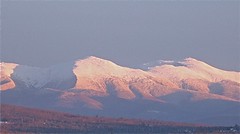
Shadows of Mt. Washington


Mt. Washington Shadows
Originally uploaded by Roadduck99


I regularly drive by New Hampshire's Mount Washington as I commute to my home away from home in Montpelier, Vermont. Combined with its neighboring peaks, Mount Washington is an imposing presence in the Northern part of the state. And yet it remains a very accessible mountain. Several towns are at its base, and the peak is accessible via car or train.

This accessibility is a conundrum. The mountain is an imposing presence, a massive hulk looming over the highway. The peak is covered with snow for much of the year, and the height of the mountain often creates its own weather. It's not particularly inviting, to say the least.

And yet there it is, a constant presence amidst north woods civilization. Routes 2 and 302 guide traffic around the mountain. Towns like Gorham and Bretton Woods dot its base. It's like living next door to a giant. You respect the mountain and aren't inclined to mess with it, but you always have the opportunity to check in and see what's going on.


The Mountain looms large over Lancaster, NH.

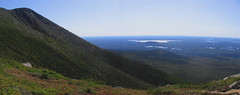
For this reason, Mount Washington has a certain appeal to me that is missing from Maine's own giant, Mount Katahdin. Katahdin is a hulk in its own right, but it's also kept separate from the populace, safely tucked away in Baxter State Park, miles away from the nearest town.


View from the top of Katahdin.

I'm certainly not saying that it's preferable to have people living on the slopes of every mountain. It's important to maintain wilderness and protect these habitats. And while wilderness has its romance, the mountains among us have a romance of their own. One can gaze up at the heights and see how they are impacted by the change in seasons, or even the day's weather.

Part of me longs to live next to this giant rock, and spend my days learning its secrets. I want to climb it, drive up it, take the train to the top. I want to visit the weather station at the summit. I want to sit on its rocks and write about the mountain surrounding me. And I want to take my camera out every day and chronicle the many moods of the mountain. I'm a mountain guy who lives next to the ocean, but my dreams take me to the hills. For now, I enjoy my periodic drives by this giant beauty.

Labels: , , , ,

Wednesday, July 08, 2009

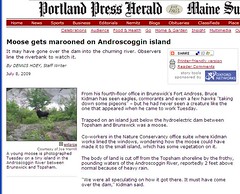
Moose in the Androscoggin


Moose in the Paper
Originally uploaded by Roadduck99

Yesterday was an exciting day at my office. A moose somehow found its way to a tiny island just below the Brunswick hydroelectric dam in the Androscoggin River between Brunswick and Topsham. Word traveled quickly and soon a steady stream of onlookers made their way to the Frank J. Wood bridge and the grounds of the Fort Andross Mill complex.


This is not normally moose country.

My office mates and I, however, didn't need to go anywhere. The window by my desk overlooks this very island. Most days we find ourselves looking for eagles or osprey, or the occasional sturgeon leaping out of the water. Today we had the best seats in the house to watch as the juvenile bull moose stood around, grazed on leaves, and bedded down for an afternoon nap. When Smilin' Dave (so named after two Niagara Falls daredevils) got up for an afternoon snack, I ran downstairs to get a better photo.

My co-workers, all keen observers of nature, observe keenly.

In a case of right place/right time, one of my photos made it into the Portland Press Herald. The lean times have left the paper short handed, and nobody was available to cover this story. So reporter Dennis Hoey called an associate of mine to get the details. Since the PPH had no camera on site, he asked if Bruce had a photo he would be willing to share. Bruce said no, "but I know somebody who did get a good shot." And the rest, as they say, is my 15 minutes of fame.

Labels: , ,

Sunday, June 14, 2009

Ecological Intelligence

“We have to stop speaking about the Earth being in need of healing. The Earth doesn’t need healing. We do.”

These words, from South African physician and naturalist Ian McCallum, close Daniel Goleman’s new book Ecological Intelligence: how Knowing the Hidden Impacts of What We Buy can Change Everything. Goleman’s book is an ambitious work that goes beyond the usual cries that humans are screwing up the planet and discusses how we can use market forces to change that behavior.

Not that Goleman ignores the fact that humans are screwing up the planet. (Or rather, screwing up the planet for humanity, as with the opening quote.) He goes into great detail to show how those of us in the US continue to pollute the air, ground, water and our bodies, long after science has shown us to be doing great harm. The reason for this is threefold: 1) Industry doesn’t change its practices because it might not be profitable to do so; 2) Government doesn’t regulate change, because political elections are financed by Industry; and 3) Consumers don’t insist on changes because we aren’t aware of the harm we are doing.

To combat this, Goleman introduces the reader to the concept of “Radical Transparancy,” wherein a product’s devalue (i.e. the harm it can do) is as readily known as its value. Studies have shown that if consumers are aware of the social, environment and especially health impacts of a product, most will change their purchasing habits even if it means spending more to buy the better product.

To illustrate, Goleman tells the tale of trans fat, which under the label “shortening” was a staple of home and industrial food production for 100 years. However, when the Institute of Medicine and the Food and Drug Administration independently issued reports at the turn of the 21st century detailing the health risks associated with trans fat, public concern reached heightened levels. When the FDA issued labeling requirements indicating the level of trans fat in foods, the agency in effect issued the death knell. Trans fat has been almost completely eliminated from foods in the US, because informed consumers do not want to buy products containing trans fats.

Not all stories are as cut-and-dried as that of trans fat. In some cases the risks are less immediate (global warming), or less personal (worker treatment), or less obvious (tainted water supplies).

To fully understand these risks, we need to understand more than simply how a product is made and how it is disposed of. We also need to understand what impacts result from the production of components, and of the subcomponents, and so forth. We also need to understand the impacts of shipping, packaging, and how the product is used. This is called “Life Cycle Analysis,” a cradle-to-grave study of a product’s impact.

One such study was made by the folks at Proctor & Gamble, who discovered that the greatest impact from its production of Tide laundry detergent was in the way the product was used. More specifically, the energy required to heat the laundry water was greater than the impacts incurred in manufacturing and transporting the product. This inspired P&G to develop a detergent that is just as effective using cold water.

Goleman treats the reader to several such anecdotes, and highlights several companies in addition to Proctor and Gamble (like Interface and (gulp!) Wal Mart) that have taken it upon themselves to improve the impacts of their businesses. Goleman also discusses the way that the US Government’s loose approval guidelines, the phenomenon of Unintended Consequences, and the corporate practice of “Greenwashing,” make it more difficult for the consumer to fully understand the impact of their purchasing practices. Thus the need for Radical Transparency.

Ecological Intelligence does a thorough job of describing the perils that face the unwitting consumer in the United States, and how industry and government work in tandem to obfuscate those perils. The reader comes away understanding that the threats to our health, the environment, and the people in third-world countries are real and avoidable. Where the book falls somewhat short is in offering solutions. This is because the Radical Transparency industry is in its infancy. The resources available to the consumer are not easily accessed at the point of sale (or, more importantly, in the aisle when the shopper is making a decision). Those that do exist still have large gaps in compiling the massive amounts of data on all products available for sale in the US.

This is an important book, and perhaps the first step in bringing the need for Radical Transparency into the collective consciousness. I believe that the population of this country is grossly unaware of the true impact of the way that we live. With the government beholden to industries that are unwilling to make risky changes that might impact the bottom line, the impetus for change must come from the grassroots. I believe that an educated population will generate the force required to shift the markets. We just need the information.

The following web sites are referenced in Goleman’s book. They have their shortfalls, but begin to provide the information that will help us change the way business is done in the US.

http://www.goodguide.com/ to find safe, healthy and green products.

http://www.cosmeticsdatabase.com/ for Skin Deep, the Cosmetics Safety Database.

Labels: , , ,

Thursday, June 11, 2009

The Termite

One of the great things about the organization that I work for is that I get to meet a lot of cool people who are doing a lot of cool things. One such cool thing was introduced by our Board member Ford Reiche, who is the CEO of Safe Handling, Inc., a transportation company in Auburn, Maine.

Ford recently became the proud owner of the Termite, a pickup truck that is powered through wood gasification technology. Ford bought the truck from a gentleman in Alabama who developed the technology through years of trial and error. Ford and his son George recently flew to Alabama and drove the Termite home - several hundred miles almost completely powered by scrap wood. What the Termite lacks in sophistication, she more than makes up for with innovation and efficiency - harmful emissions are lower than even hybrid vehicles.

Ford showed off his baby at a recent board meeting at the Samoset Resort in Rockland, Maine. The story of the technology, the guy who built this machine, and the misadventures encountered on the drive home, are best shared directly through his own blog. Here I will share a few photos that I took while he was showing off this baby the other day.


That's the engine in back - hay filter, heat exchanger and burn chamber. The termite gets about one mile per pound, or 40 miles per "tank" of scrap wood.


The rails are actually the radiator that cools the engine. The bright green paint is simply eye-catching.

Ford Reiche, looking every bit the mad scientist.

The gauges must be read through the rear view mirror. They are scaled differently as well.

Labels: ,

Friday, April 17, 2009

You Don't Say?

According to the EPA, greenhouse gases are bad for us.

Next thing you know, they'll come out against cigarettes.

Labels:

Sunday, April 22, 2007

Solutions Plus

Saturday was a gloriously sunny and warm day in Southern Maine. So I spent it, along with my wife and a few other committed individuals, inside the theater at Frontier Cafe. The event was Solutions + Saturday, the brainchild of Fred Horch, proprieter of F.W. Horch Sustainable Goods in Brunswick. Solutions + Saturday was the culmination of a series of events celebrating Earth Week at the Cafe.

The were four topics examined, all of which centered around short films followed by discussion.
*Recycling
*Local and Organic Food
*Household Chemicals
*Energy and Climate Change

Each of these topics is worthy of it's own post, or even series of posts, and I intend to touch on them all in a series over the next few days or couple of weeks. I've certainly written a fair amount about Global Warming, and the economics of eating local food has been an interest of mine as well. I haven't thought as much about household chemicals, but the discussion related to pesticides, vinyl products, and other poisons that we readily bring into our homes was a real eye-opener.

The first topic, recycling, is to me a no-brainer. It is so clear to me that the foundation to protecting the planet is the mantra "Reduce, Reuse, Recycle" that it is fundamental to all decisions that I make. The discussion on Saturday centered around the new single-stream recycling system in Brunswick. Students at Bowdoin College made a short film called "The Quest for Dan the Can" to educate other students about the changes in the recycling program. The film took us to the Brunswick landfill, and the recycling processing facility in Avon, Mass.

Discussion following the film centered around the Brunswick program, what can and can not be recycled, and a few myths. One myth discussed was the common misconception that it takes more energy to recycle an aluminum can than to create a new one. This only accounts for the actual can manufacturing process. Of course, a new can requires energy to extract the raw materials, transport the raw materials, and transform the raw materials into aluminum. Once all of these uses are accounted for, the energy cost of a new can far exceeds that of a recycled one.

Other interesting facts are that metals and glass do not degrade in the recycling process, so these materials can be recycled into the same products indefinitely. Fiber-based materials like paper do degrade, so can only be recycled into lower-grade materials. Certain plastics can be recycled indefinetely (#2 PET), however plastics all have some sort of pesky toxin issues, as well as the pesky petroleum-based issue for most (there are some vegetable-based plastics now on the market.)

One topic that was not discussed, perhaps do to time, is the concept of "precycling", which can also fall under the "reduce" category. Precycling can take a couple of forms. One form that I use a lot is buying in bulk and reusing containers at home. This reduces the amount of packaging associated with your purchases. Another form is to buy products whose producers have chosen to minimize the packaging for their products. One could also let the manufacturer know that one of the reasons that you buy their products is due to the limited packaging. (Do as I say, not as I do. I think this is a great idea that I may have done once in my life!). The final form of precycling is, if you can't avoid packaging, to purchase products enclosed in recycled packaging, preferably post-consumer material if possible. Again, let the manufacturer know that their packaging decisions matter to you.

I commend Fred Horch and Frontier for running this program. The only downside was that the public participation was very light. I know that Frontier and F.W. Horch publicized the event fairly heavily, but the weather certainly wasn't in their favor, especially considering the storms that we have suffered recently. It wasn't a good day to be inside. Still, there was lively discussion of all topics, and all are very important topics for the health of the planet and those who inhabit it, including humans. After attending the presentations, it is my pledge to bring these topics to an even broader audience - you the loyal reader. Stay tuned!

Labels: ,

Monday, April 16, 2007

Polar Bears Step it Up

Keepin' it cool for the Polar Bears

Saturday was the day that people gathered at over 1,400 locations across all 50 states to encourage our lawmakers to Step It Up! and enact legislation to cut carbon emissions and fight global warming. Participants certainly numbered in the tens of thousands in this grassroots effort to put democracy in action and make their voices heard.

I attended the Polar Bear Action at Bowdoin College in Brunswick. The Polar Bear is Bowdoin's mascot, and is the current poster child for species threatened by global warming (in the case of the polar bears, the issue specifically relates to shrinking ice sheets). Approximately 400 students, faculty and members of the community gathered to for food and music, and appearances by Representative Tom Allen and an aide to Senator Susan Collins. Following the speeches, participants marched down Maine Street carrying signs and chanting our encouragement for the government (and the people) to fight this global crisis. Additionally, hundreds of letters addressed to the local state reps and Maine's Washington contingent were signed encouraging their action.

Rally time.

All of us need to recognize the grave danger that we are putting the human race into, and the even graver danger for many of our population centers. Our continued dependence upon carbon-based fossil fuels is certainly speeding our own demise. We need to consider not only our energy choices, but the impact of all of our consumer choices - local food versus global agriculture, local vendors vs. sprawl-inducing big boxes and the like. Please take a moment to learn more about how your choices are impacting the globe.

Labels: ,

Tuesday, July 25, 2006

Ecology of a Cracker Childhood

The summer reading series continues this week with a review of Ecology of a Cracker Childhood by Janisse Ray. The book was published in 1999 by Milkweed Editions, and was recently brought to my attention when Ms. Ray was the keynote speaker at a conservation meeting that I attended recently. Ray is a naturalist and activist who grew up in southern Georgia and now resides in Vermont.

Ecology of a Cracker Childhood is equal parts memoir and tribute to the longleaf pine forest that once dominated the landscape of Georgia. Ray grew up as the child of a deeply religious patriarch who owned a junkyard along Highway 1 in Baxley, Georgia. Ray recounts her family history beginning with her great grandfather. Her family were "Crackers," the hard-drinking, hard-fighting Scottish immigrants who settled in Southern Georgia. Ray's grandfather was an enigma, prone to bouts of violence and lenghty disappearances into the forests. Ms. Ray portrays her grandfather as inseparable from the wildlife that populates the forest, and therefore sees herself and her people as one with the landscape. It is upon this foundation that the story is built.

The longleaf pine forest is largely a thing of the past in Georgia. The trees have been heavily logged and subsequently converted to slash pine forest or development. The resultant impact on the entire ecosystem is profound, even where the land remains forested. Longleaf pine has been replaced with slash pine, which grows more quickly and therefore generates more income than it's slow-growing cousin. However, the slash also grows more thickly than the longleaf and chokes out the understory. Sections of the forest that have been developed have fragmented the landscape. Ray walks us though how these developments have endangered the flora and fauna associated with the longleaf forest. Wiregrass and pine savannahs, Indigo Snakes and Gopher Tortoises, Flatwoods Salamanders and Bachman's Sparrows, all are evolved to live among the longleaf pines. Human greed and gluttony, the impulse to cut and sell every last tree in the forest, imperil these living things and many more. Ray's compassion for the survival of the forest invoked the New York times to consider her the Rachel Carson of the Southeast forests. (See my sidebar, below.)

While the discussion of the longleaf forest is compelling, it is Ray's recounting her family history that sets this book apart from what one would expect from a "nature" book. Ray speaks frankly about the violent nature of her father, grandfather, and other ancestors. She also speaks frankly about the mental illness that gripped many of these same men. Her grandfather, Charlie Ray, is consumed both with illness and violence, and he proves to be the most fascinating character in the book. Charlie Ray was essentially a feral man, posessing a violent streak and a communion with wild animals that evokes the image of a man raised by wolves. His stories are the most entertaining, but it is Ray's father who is the most dominant personality in the book, the one who seems to have had the greatest impact on the young Janisse.

Frank Ray was a devout man, a strict disciplinarian who did not allow a television in his house. He dealt in scraps, running a junkyard and making a living bartering for items that many people simply throw away. It was a struggle to provide for his four children, and they were quite poor, though never without food on the table. Frank Ray did not shy away from using a belt to discipline his children, and he also had a bout with mental illness. Janisse Ray recounts these facts without judgement, and she makes a point to ensure the reader that she knew that her father loved her and her siblings profoundly. It's an honest reflection of real life, but the relationship feels unresolved in this book. Perhaps this is by design, as most relationships are not lent to simple resolutions, and regardless, Frank Ray is still alive. I'm sure that the relationship continues to evolve.

It is the descriptions of Ray's childhood that were most challenging for me as a reader - not due to the content in any way, but in my personal relationship to the era. Because Janisse Ray had such a rural upbringing, with no television and with a junkyard as a playground, the stories evoked mental images of the 1940s. However, Janisse Ray is a direct contemporary of mine, having been born just three years before me. We grew up at the same time and in the same country, yet the stories seem quite distant to me. It is doubtless, however, that my reality and hers crossed paths. Ray may have gone to school in dresses sewn by her mother, but she certainly had classmates who wore the ghastly polyester fashions that were in vogue during the 1970's. She may have grown up without a television, but she attended school with kids who spent lunch hours discussing the prior evening's episode of Mork and Mindy. It's a challenge to me, because I don't believe that my personal experiences are worthy of a memoir, but I find Janisse Ray's to be a very interesting story.

Ray's concern for the forests, and her deeply personal memoirs, are enough to make this book a recommended read. One other aspect that truly sets the book apart is Ray's writing style, which at times evokes heartfelt emotion and, at it's best, waxes into pure poetry. Consider this passage as Ray describes spending a night in the pine savannas:

At evening in a Southern coastal-plain savanna, chuck-will's-widows call from the piney flatwoods a quarter mile upland. Not a rustle or hoof fall punctures the peace, except one moaning howl a mile a way that might be coyote or wildcat. Half the moon, like a broken dinner plate, poises directly overhead and the stars begin to appear, first in the nimbus of moon, then one by one across the lit sky. Soon a canopy of purple velvet is sewn with diamond flecks above the thick and hillocked grasses.

The dreaming is deep.

In the morning, a strip of pink pools through the slash pines in the lowland east. The fog is a garden wall made both of stone and imagination. In the garden a million million spiderwebs are spun of strands of dew - dream catchers, wind nets, hammocks of dawn. There are thousands of them, a revolution of spiderwebs in an anarchy of fog. It is like an ocean of webs, every tussock slung with a diaphanous nightcap.
The words are rich with imagery, and draw the reader into this beautiful part of the world that bears preserving. While the subject matter isn't always a pleasant read, Ecology of a Cracker Childhood never fails to compel.

Labels: ,

Sidebar: The Rachel Carson Comparison

Ecology of a Cracker Childhood has a snippet from the review by the New York Times prominently displayed on the front cover:

"The forests of the Southeast find their Rachel Carson."

Well, maybe. Maybe not. This is in no way meant as a criticism of Ms. Ray's book, which I thoroughly enjoyed. I'm just not sure that the Carson comparison is apt. Then again, I'm not sure that it isn't appropriate, as I've never read Rachel Carson's work.

You see, I also recently read Suburban Safari by Hannah Holmes. Prominently displayed on the front cover is this snipped from the review by
Entertainment Weekly:

"Holmes is a Rachel Carson for 21st-century suburbia."

Having read these books just a few weeks apart, I can easily say that they are so vastly different that it is very unlikely that both authors resemble Rachel Carson. Yes, all three are concerned about humanity's impact on the other inhabitants of this planet. All three are also female. With Ray and Holmes, the comparison pretty much ends there. Holmes is witty, whimsical and scientific. Ray is poetic, introspective and emotional. Ray spends a lot of time talking about populations, while Holmes dedicates many pages to discussing individuals.

It is quite possible that more appropriate comparisons could be made to Audubon, Muir, Thoreau, or any of a host of other people who have written about nature. (Unfortunately, I haven't read a ton from these guys either, so I can't suggest who best fits with whom.) These writers need not be compartmentalized based solely upon their gender. When Rachel Carson's name is thrown about so liberally in these reviews, it begins to appear a bit trite.

Labels: ,

Monday, February 27, 2006

The North Maine Woods

I'm sitting outside the Cosi coffee shop in the Ballston section of Arlington, VA. My plane to Maine leaves in about three hours, and it's too nice outside to be sitting in an airport. Reagan National is less than a half hour from here via the Metro rail service. I'm in town for orientation and training - two days of power point presentations followed by a field trip to the Potomac Gorge reserve in nearby Maryland.

Today's weather was ideal for the hike. I had some concern earlier in the week, because the area was hit by a foot of snow over the weekend. However temperatures soared into the 60's, and we had ideal conditions for what turned out to be a three hour hike over the rocky trails. There were still pockets of snow on the ground, but they did not really impede our footing.

I was overdressed from the beginning, and had to shed several layers during the trek until I was down to my tee shirt. This was a far cry from the conditions that I met on a field trip just a week earlier. Instead of the hustle and bustle of the nation's Capital, I was far up in the Maine woods. I was in the upper St. John River area of Aroostook County, in unincorportated towns that, for the most part, don't even have names. They go by cryptic code letters, "T12 R17" and the like (which stands for Township 12, Range 17). Locals just use the numbers. "Twelve Seventeen" is all the information one needs, though a few do carry fancier handles like "Big Ten Township".

The area sounds remote, even for Maine, and it is. In fact, from certain parts of the state it is easier to get there by leaving the country and driving through Quebec, Canada for part of the journey. This is exactly what our party did. However, it is unwise to assume that the area is largely devoid of human activity.

This was a surprise to me. In looking at the state of Maine, one sees the western half of Aroostook County (along with the northern portions of several other counties) as vast wilderness, with no towns and little reason for anybody to go there. However, if one looks at a map that also shows Quebec, one sees a series of towns that dot the Maine border. These towns are populated by people who do one of two things, farming and lumbering. Those in the forestry industry cut a lot of lumber in Quebec. They also cut practically all the lumber in this part of Maine. One can not last long in this endeavor without being able to speak French, because most Quebecois don't speak any English whatsoever.

The border crossings aren't the busy entry points seen along the major thoroughfares of the state. They see a few dozen people a day, usually the same few dozen people every day. Because the logs are sold into lumberyards on the Canadian side of the border, some pulp truck operators may cross a few times per day, depending on where the lumber is being harvested. In general, border crossings are pretty uneventful. Even the US guards seem to recognize that a terrorist would be going pretty far out of his way to cross at St. Juste and navigate the logging roads to gain entry into the country.

The logging roads are legendary in Northern Maine. The first rule to remember is that the pulp trucks have the right of way. These roads are owned by the timber operators and they are, first and foremost, there for the forestry industry. The trucks go fast, and they aren't going to move over for any four wheeled vehicles. If you see one heading your way (which isn't always a given on the windier parts), you need to slow down, move over, and give a friendly wave as the truck goes by. The main roads are barely wide enough for two vehicles during the summer months, and they are downright snug with snow piled on either side. It's also worth noting that the road beds are primarily ice-covered, so the driving is slick. That doesn't appear to deter anybody from driving well above the posted 40 mph speed limit.

When I left on the St. John trip there was no snow cover in Southern Maine. That was the case for much of the drive north, with such outposts as Bingham and The Forks showing bare ground. Not until we were in the snowmobiling town of Jackman, almost to the Canadian border, was there consistant snow cover. Driving north through Quebec, however, it’s apparent that winter is in full force. Several feet of snow were on the ground and large snow banks lined the streets and driveways. Much of the land consists of open fields dedicated to farming, and the constant wind sweeps drifts of snow that need to be shoveled days after the last storm. The towns are very utilitarian-looking, with functional homes nestled close together and sitting close to the roads. There are no subdivisions, and nearly all of the homes are along the main roads. There are a few grocers, gas stations and maybe a restaurant or two. It gives all the appearance of a hardscrabble life, and harkens back to the US of 40 years ago, before formulaic chain stores homogenized the landscape.

There is very little industry along Quebec – Maine border. Other than farming, the towns of Daquaam, St. Pomfrey, St. Juste and others of the region simply serve the timber industry of Easten Quebec and Western Aroostook County in Maine. Men cross the border into Maine to harvest the wood, and the wood crosses the border back into Quebec, where the lumber yards sell it to paper mills or saw mills. Part of what makes this region of Maine so mysterious and magical is the lack of a human population, however there is a great deal of economic potential in the woods that is being exploited by the Canadian population just a few miles away. And in fact, while these are truly “deep woods”, it is not virgin forest. Most of the timber has been cut several times over the past couple of centuries. I’m certain that the forestry practices have affected the mix of the tree species in some townships, but here is living proof that forestry is a long-term sustainable industry. In fact, the land that we are visiting is conservation land, part of which is acting as a sort of laboratory to test the impacts of new silvacultural techniques designed to maintain the makeup of the forest, and conserve parcels that have unique or interesting characteristics. This is humanity coexisting with nature, where both people and animals are sustained by the wild forest.

The wilds of the St. John River are also treasured for the wildlife. Wildlife abounds – moose, lynx, marten, otters, and snowshoe hares are abundant. Bears roam the territory in the warmer months, however they are deep into their winter hibernation during my visit. There is some snowmobiling activity in the region, however the access is too limited for there to be many cross country skiers or snowshoers. There are many cabins along the river that are used by hunters and fisherman. They are accessible by canoe, although the river is very shallow for much of the year and canoeing trips can involve a fair amount of carrying as well. The cabins are very austere, usually one room with a woodstove and a bunk or two. The people who inhabit them (most are leased by the same individuals for many years) don’t need much in the way of modern conveniences. It’s truly frontier living.

The North Maine woods are a region unlike many others in the country. Most undeveloped land in this country is difficult to access – mountains or barren land. This is not the case in Aroostook County. The terrain consists of the same rolling hills of the towns across the border, very similar to the foothills found in Oxford and Franklin Counties in the southern part of the state. However nobody has chosen to build a town amidst wide expanses of the forest, and as such it is the largest contiguous forest remaining in the United States. It is wild and unique and, as such, is a treasure. There are sexier portions of the North Maine Woods that are currently under development pressure. It’s beautiful country, but it’s beautiful because humans haven’t made it look like the rest of the country. My hope is that we see it in our hearts to keep part of the wilderness wild, and maintain the treasures that the wilderness houses.

Labels: ,

Tuesday, October 25, 2005

The Wombat Knows

At Global Community.org, there is a wise wombat who explains that we have only one planet, and we have to take care of it and share (nicely!) with our neighbors. If a wombat can figure it out, why can't more people do so?

Labels: